
Black Mold: How to DIY It and When to Call a Professional
You find it in the corner of the shower, around a window frame, or on the wall behind the toilet: fuzzy, dark, and smelling like a wet basement. Somebody in the house says the words “black mold” and everybody gets nervous.
Take a breath. Most small patches on hard surfaces are a job you can do yourself in an afternoon. The thing that decides whether it stays gone is not the cleaner you pick. It is whether you find and stop the water that fed it.
This is the hands-on guide for the small jobs. If you are still deciding whether the job is yours at all, start with our DIY vs professional mold removal decision guide.
Do not worry about the color. Worry about the size.
“Black mold” usually means Stachybotrys chartarum, a dark mold that shows up on materials that stay wet, like drywall, ceiling tile and wood. But molds come in many colors, and the EPA shows both white and black molds in its own guide. Color alone tells you very little.
The CDC cuts through the panic:
You do not need to know the type of mold.
Centers for Disease Control and Prevention, Mold
The CDC also does not recommend mold testing. Whatever the type, you remove it and fix the moisture. So skip the lab kit and get a tape measure instead.
The EPA sets the line at about 10 square feet, roughly a 3 foot by 3 foot patch. Under that, on a hard surface, with the leak already fixed, most homeowners can handle it. Over that, or after a flood or sewage backup, call a professional.
Mildew or mold: a quick way to tell.
Mildew is a surface growth. It looks flat and powdery, usually white, gray or light brown, and often shows up on shower grout and window sills. It wipes off with detergent and does not come back as long as the area stays dry.
Mold that looks fuzzy or slimy, sits in a dark stain, or comes back right after you clean it has usually worked into the material. On drywall, that often means the paper face and the gypsum behind it are wet.
Gear up before you touch it.
Scrubbing mold throws spores into the air. The EPA brief guide to mold recommends this kit:
- An N-95 respirator, which the EPA says runs about $12 to $25 at a hardware store. It has to fit snug to work.
- Long gloves that reach the middle of your forearm. Plain household rubber gloves are fine with water and detergent.
- Goggles without ventilation holes.
- Old clothes you can wash right away, or throw out.
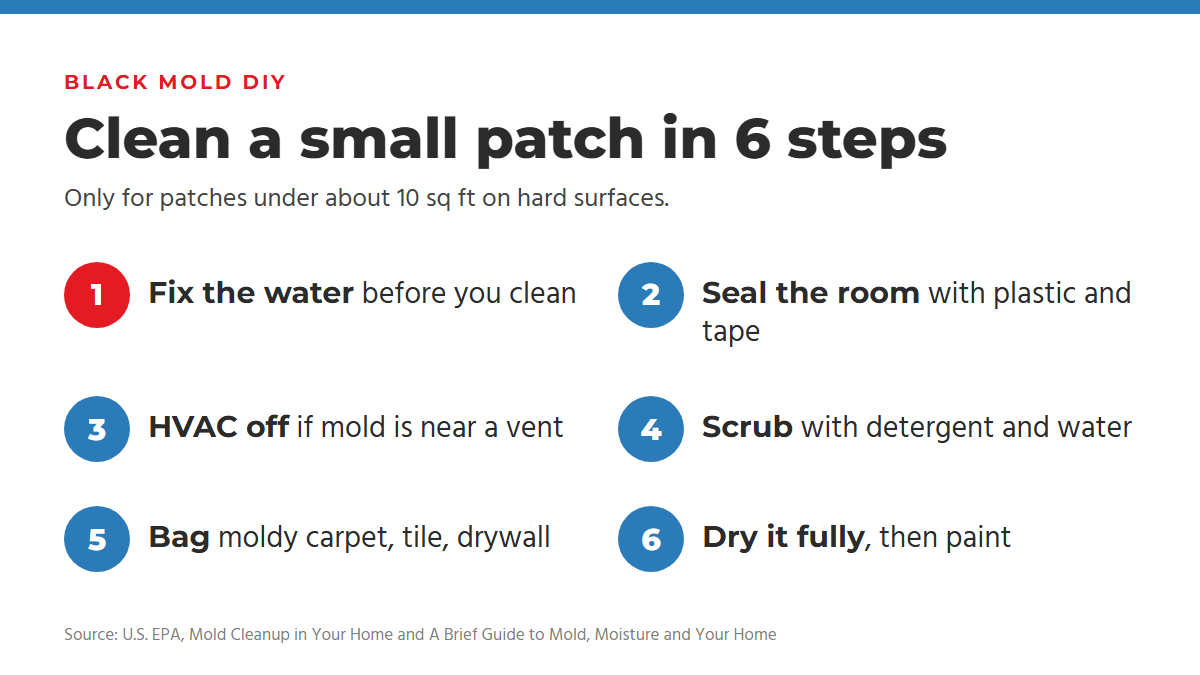
Clean a small black mold patch in six steps.
- Fix the water first. Tighten the fitting, replace the wax ring, run the bath fan, or call a plumber. Cleaning before you fix the leak just resets the clock.
- Close off the room. Shut interior doors, cover the doorway with plastic sheeting and tape, and lay plastic on the floor. Open a window to the outside if you can.
- Turn off the heating and air if mold is anywhere near a vent or return. The EPA warns that running a contaminated system can spread mold through the building.
- Scrub hard surfaces with detergent and water. That is the EPA’s own method. Use a stiff brush, rinse the brush often, and wipe the area clean.
- Bag what you cannot clean. Moldy ceiling tile, carpet, insulation and soaked drywall usually have to go. Mold grows into the empty spaces of porous materials and may be impossible to remove completely.
- Dry it fast and completely. Fans and a dehumidifier. Do not paint or caulk until it is clean and dry, because paint over mold just hides it.
Skip the bleach cocktail.
A lot of online advice says to douse mold in bleach. The EPA does not recommend chlorine bleach or other biocides as a routine part of mold cleanup, because the goal is removal. The EPA also notes it is usually not possible or desirable to sterilize an area: a background level of spores will remain, and they will not grow once the moisture problem is fixed.
If you do use bleach on a hard surface, use one product at a time and keep the window open. The EPA puts the warning plainly:
Never mix chlorine bleach solution with other cleaning solutions or detergents that contain ammonia because toxic fumes could be produced.
U.S. EPA, A Brief Guide to Mold, Moisture and Your Home
Five signs to stop scrubbing and call a pro.
- The growth is larger than about 10 square feet, or you keep finding more as you go.
- It comes back within a few weeks of cleaning, which means the water source is still there.
- You can smell mold but cannot see it. It is likely inside a wall, under flooring or in the ductwork.
- It followed a flood, a sewage backup or a leak that sat for days.
- Someone in the house has asthma, mold allergies or a weakened immune system. The CDC says people with asthma or mold allergies may have severe reactions.
Hit one of those? Call us before you open the wall. Apex answers 24/7, a real person picks up, and we bill your insurance company directly so you are not stuck in the middle. Call (931) 434-0877 or send us a message through our contact page.
Keep black mold from coming back.
Mold needs water. Take that away and it cannot grow. The EPA’s prevention list is short:
- Keep indoor humidity below 60 percent, ideally 30 to 50 percent. A cheap humidity meter tells you where you are.
- Run the bathroom fan or open a window when you shower, and vent the dryer outside.
- Fix leaks as soon as you find them, and dry anything wet within 24 to 48 hours.
- Keep gutters clean and make sure the ground slopes away from the foundation.
- Insulate cold water pipes that sweat in summer.
Humidity is the big one across Tennessee. Our Coffee County crawl space study shows why so many homes here carry moisture under the floor, which is where a lot of musty smells start. If the mold showed up after a leak, our guide to the dos and don’ts of water damage cleanup covers what to do with the wet materials.
Call Apex when the patch is bigger than you are.
Apex Restoration DKI provides professional mold remediation across Tennessee, including our Memphis office and our Smyrna office south of Nashville. We find the water, contain the area, remove what has to go and dry the structure before anything gets rebuilt.
Got a patch that keeps coming back? Apex answers 24/7, a real person picks up, and we bill your insurance company directly so you are not stuck in the middle. Call (931) 434-0877 or send us a message through our contact page.