
How to Create a Home or Business Fire Evacuation Plan

It is 2 a.m. and the smoke alarm goes off. You are half asleep, the hallway is filling with smoke and you can’t see the bedroom door across from yours. Whatever you practiced is what your body will do next.
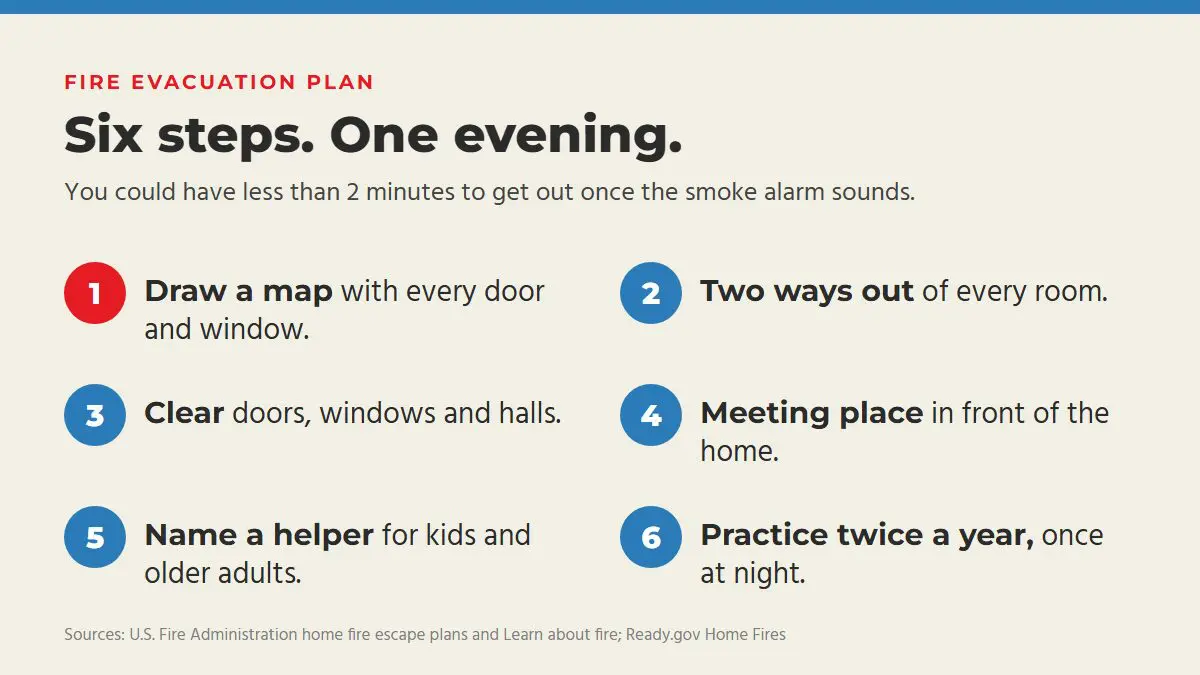
That is why a plan matters. The U.S. Fire Administration says you could have less than 2 minutes to escape a home fire once the smoke alarm sounds. A fire evacuation plan turns those two minutes into a route everyone already knows.
Start your plan tonight in four steps
- Draw a map of your home or building with every door and window.
- Mark two ways out of every room.
- Pick one meeting place outside, in front of the building.
- Run a drill this week by pushing the smoke alarm’s test button.
Draw the map and find two ways out of every room
Grab a sheet of paper and sketch each floor. The USFA home fire escape plan guidance keeps it simple: include all doors and windows, find 2 ways out of every room and make sure doors and windows are not blocked. The second way out matters because the first one is usually the hallway, and the hallway is where smoke collects.
Then go test the windows. They should open without a fight, screens should pop out quickly and any security bars need a quick-release that everyone in the house can work. A painted-shut window is not an exit.
Remember that every second counts in the event of a fire. Escape plans help you get out of your home quickly.
Ready.gov, Home Fires
Pick a meeting place in front of the building
Choose something fixed and easy to name: the mailbox, the neighbor’s oak tree, the light pole at the end of the drive. Put it in front, where firefighters arrive. Once everyone is there, you can count heads in seconds.
If someone is missing, do not go back in. Call 911, tell the operator exactly where that person is likely to be and tell firefighters the moment they arrive. Do the same for pets.
Practice twice a year, including once in the dark
Ready.gov recommends practicing your plan twice each year. Make one of those a night drill. It is not fun, but it is the only way to learn who sleeps through the alarm.
- Start the drill by pushing the smoke alarm’s test button so everyone learns the sound.
- Practice feeling your way out with the lights off or eyes closed.
- Crawl low under imaginary smoke. Heat and smoke collect at the ceiling first.
- Before opening a door, feel the door and knob. If either is hot, use the second way out.
- Time it. Then do it again until it is fast and boring.
If anyone sleeps through the alarm, add alarms. The USFA recommends smoke alarms inside and outside each bedroom and sleeping area, and interconnected alarms so that when one sounds, they all sound. Sleeping with bedroom doors closed also buys time.
Keep both routes clear every day
Laundry baskets in the hall, boxes in front of the back door, a bookcase under the bedroom window. Clutter builds slowly and you stop seeing it. Walk both routes once a month and clear anything that would trip you in the dark.
Give kids, older adults and anyone who needs help a named helper
Babies and young children can’t get out alone. The USFA guidance for families with children says to plan who will wake and help each child. Do the same for an older parent, anyone with a disability and anyone who uses a walker or wheelchair. Check that every exit they need is wide enough to get through.
Name a backup helper too, in case the first person can’t reach them. Our post on teaching your kids fire safety covers how to drill the kids without scaring them.
Know what to do if you can’t get out
If both ways out are blocked, Ready.gov says to close the door, cover vents and cracks around the door with cloth or tape to keep smoke out, call 911 and tell them where you are. Signal at the window with a light-colored cloth or a flashlight.
For businesses: put the plan in writing and account for everyone
A business plan follows the same logic with more people and more paperwork. Where an OSHA standard requires an emergency action plan, federal rules say what goes in it.
An emergency action plan must be in writing, kept in the workplace, and available to employees for review. However, an employer with 10 or fewer employees may communicate the plan orally to employees.
OSHA, 29 CFR 1910.38
Even if OSHA’s rule doesn’t apply to your shop, its minimum elements are a good checklist:
- How employees report a fire or other emergency.
- Evacuation procedures and exit route assignments.
- How you account for every employee once they are out.
- Who to contact, by name or job title, for questions about the plan.
- In multi-story buildings, use the stairs, not the elevator, unless the fire department directs otherwise.
Make digital copies of insurance policies and key documents and store them off-site, so you can start the claim from a phone in the parking lot. If a fire does hit your building, our commercial and residential restoration services are built to get you open again.
Once everyone is safe, call Apex
A plan gets your people out. What happens to the building next is our job. Apex Restoration DKI handles fire damage restoration from emergency board-up through soot cleanup, odor removal and rebuild. Find the office nearest you on our locations page, and keep our guide on how to put out common house fires handy for the small stuff.
When the fire trucks leave, call us next. Apex Restoration DKI answers 24/7, and a real person picks up, not voicemail. We bill your insurance company directly, so you are not stuck fronting the cost while the claim works itself out. Call (931) 434-0877 or request help from our contact page.